< IP_TOS & SIO_ADDRESS_LIST_QUERY Examples | Socket Options & IOCTLs Main | SIO_GET_BROADCAST_ADDRESS & SO_KEEPALIVE_VALS Examples >
Socket Options and IOCTLs 7 part 6
What do we have in this chapter 7 part 6?
-
Setting the IOCTL SIO_ENABLE_CIRCULAR_QUEUEING Program Example
-
The SIO_GET_ATM_ADDRESS Program Example
|
|
Setting the IOCTL SIO_ENABLE_CIRCULAR_QUEUEING Program Example
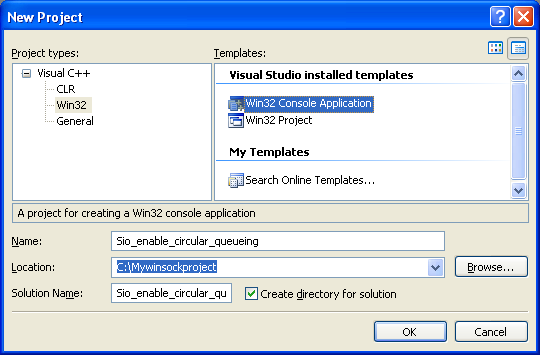
Create a new empty Win32 console mode application and add the project/solution name.
Add the following source code.
// Description: // This sample shows how to set the ioctl SIO_ENABLE_CIRCULAR_QUEUEING. // This ioctl is very difficult to prove that it works. You need to // start blasting datagram packets as quickly as possible and capture // the results with Microsoft Network Monitor to find out which packets // got dropped. |
//
// No command Line arguments
// Sio_enable_circular_queueing
//
// Link to ws2_32.lib
#include <winsock2.h>
#include <ws2tcpip.h>
#include <stdio.h>
// Function: main
// Description:
// Load Winsock, create a socket, and set the ioctl. Afterwards
// call the ioctl again to retrieve its value.
int main(int argc, char **argv)
{
WSADATA wsd;
SOCKET s;
int ret;
DWORD dwBytesRet;
BOOL bOpt;
// Load Winsock
if (WSAStartup(MAKEWORD(2,2), &wsd) != 0)
{
printf("WSAStartup() failed with error code %d\n", WSAGetLastError());
return -1;
}
else
printf("WSAStartup() is OK!\n");
// Creat a socket
s = WSASocket(AF_INET, SOCK_DGRAM, IPPROTO_UDP, NULL, 0, WSA_FLAG_OVERLAPPED);
if (s == INVALID_SOCKET)
{
printf("WSASocket() failed with error code %d\n", WSAGetLastError());
return -1;
}
else
printf("WSASocket() is OK!\n");
// Set the ioctl
printf("Setting the ioctl...\n");
bOpt = TRUE;
ret = WSAIoctl(s, SIO_ENABLE_CIRCULAR_QUEUEING, &bOpt, sizeof(bOpt), NULL, 0, &dwBytesRet, NULL, NULL);
if (ret == SOCKET_ERROR)
{
printf(" WSAIoctl(SIO_ENABLE_CIRCULAR_QUEUEING) failed with error code %d\n", WSAGetLastError());
return -1;
}
else
printf(" WSAIoctl(SIO_ENABLE_CIRCULAR_QUEUEING) is OK!\n");
// Get the ioctl
printf("Getting the ioctl...\n");
ret = WSAIoctl(s, SIO_ENABLE_CIRCULAR_QUEUEING, NULL, 0, &bOpt, sizeof(bOpt), &dwBytesRet, NULL, NULL);
if (ret == SOCKET_ERROR)
{
printf(" WSAIoctl(SIO_ENABLE_CIRCULAR_QUEUEING) failed with error code %d\n", WSAGetLastError());
return -1;
}
else
printf(" WSAIoctl(SIO_ENABLE_CIRCULAR_QUEUEING) is OK!\n");
if (bOpt == TRUE)
printf("Circular queuing is TRUE!\n");
else
printf("Circular queuing is FALSE!\n");
// Cleanup
if(closesocket(s) == 0)
printf("closesocket() should be fine!\n");
else
printf("closesocket() failed with error code %d\n", WSAGetLastError());
if(WSACleanup() == 0)
printf("WSACleanup() is OK!\n");
else
printf("WSACleanup() failed with error code %d\n", WSAGetLastError());
return 0;
}
Build and run the project.

The SIO_GET_ATM_ADDRESS Program Example
Create a new empty Win32 console mode application and add the project/solution name.

Add the following source code.
#include "support.h"
#include <stdio.h>
int main(int argc, char **argv)
{
WSADATA wsd;
SOCKET s;
DWORD deviceID, bytes, dwAddrLen = 256;
ATM_ADDRESS addr;
SOCKADDR_ATM atm_addr;
char szAddress[256];
WSAPROTOCOL_INFO pProtocolInfo;
if (WSAStartup(MAKEWORD(2,2), &wsd) != 0)
{
printf("WSAStartup() failed with error code %d\n", WSAGetLastError());
return -1;
}
else
printf("WSAStartup() is OK!\n");
if (FindProtocol(&pProtocolInfo) == FALSE)
{
printf("FindProtocol() returned NULL for ATM. Check the ATM adapter/NIC!!\n");
WSACleanup();
return -1;
}
else
printf("FindProtocol() returned something for ATM!\n");
s = WSASocket(FROM_PROTOCOL_INFO, FROM_PROTOCOL_INFO, FROM_PROTOCOL_INFO,&pProtocolInfo, 0, WSA_FLAG_OVERLAPPED);
if (s == INVALID_SOCKET)
{
printf("WSASocket() failed with error code %d\n", WSAGetLastError());
WSACleanup();
return -1;
}
else
printf("WSASocket() is OK!\n");
deviceID = 0;
if (WSAIoctl(s, SIO_GET_ATM_ADDRESS, (LPVOID) &deviceID,
sizeof(DWORD), (LPVOID) &addr, sizeof(ATM_ADDRESS),
&bytes, NULL, NULL) == SOCKET_ERROR)
{
printf("WSAIoctl() error %d\n", WSAGetLastError());
WSACleanup();
return -1;
}
else
printf("WSAIoctl() is OK!\n");
ZeroMemory((PVOID)&atm_addr, sizeof(atm_addr));
atm_addr.satm_family = AF_ATM;
atm_addr.satm_number.AddressType = ATM_NSAP;
atm_addr.satm_number.NumofDigits = ATM_ADDR_SIZE;
atm_addr.satm_blli.Layer2Protocol = SAP_FIELD_ANY;
atm_addr.satm_blli.Layer3Protocol = SAP_FIELD_ABSENT;
atm_addr.satm_bhli.HighLayerInfoType = SAP_FIELD_ABSENT;
memcpy(atm_addr.satm_number.Addr, &addr.Addr, ATM_ADDR_SIZE);
ZeroMemory((PVOID)szAddress, sizeof(szAddress));
if (WSAAddressToString((LPSOCKADDR)&atm_addr, sizeof(atm_addr), &pProtocolInfo, (LPWSTR)szAddress, &dwAddrLen))
{
printf("WSAAddressToString() error %d\n", WSAGetLastError());
return(FALSE);
}
else
printf("WSAAddressToString() is fine!\n");
printf("The atm address (if any): <%S>\n", szAddress);
// Cleanup
if(closesocket(s) == 0)
printf("closesocket() should be fine!\n");
else
printf("closesocket() failed with error code %d\n", WSAGetLastError());
if(WSACleanup() == 0)
printf("WSACleanup() is OK!\n");
else
printf("WSACleanup() failed with error code %d\n", WSAGetLastError());
return 0;
}
Add new header file, support.h.

Add the source code.
// Link to ws2_32.lib
#include <winsock2.h>
#include <ws2atm.h>
// Prototypes
int GetNumATMInterfaces(SOCKET s);
BOOL GetATMAddress(SOCKET s, int device, ATM_ADDRESS *atmaddr);
BOOL FindProtocol(WSAPROTOCOL_INFO *lpProto);
void AtoH( CHAR *szDest, CHAR *szSource, INT iCount );
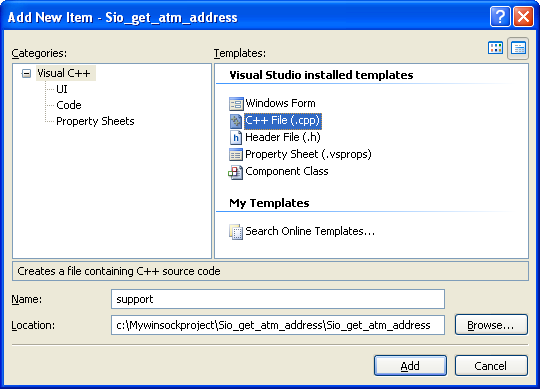
Add the header file definition, support.cpp.
--------------------------------------------------------------------
Add the source code.
#include "support.h"
#include <stdio.h>
UCHAR BtoH( CHAR ch );
int GetNumATMInterfaces(SOCKET s)
{
DWORD dwNum, nbytes = sizeof(DWORD);
if (WSAIoctl(s, SIO_GET_NUMBER_OF_ATM_DEVICES, NULL, 0,
(LPVOID)&dwNum, sizeof(DWORD), &nbytes, NULL, NULL) == SOCKET_ERROR)
{
return -1;
}
return dwNum;
}
BOOL GetATMAddress(SOCKET s, int device, ATM_ADDRESS *atmaddr)
{
DWORD bytes;
if (WSAIoctl(s, SIO_GET_ATM_ADDRESS, (LPVOID)&device, sizeof(DWORD),
(LPVOID)atmaddr, sizeof(ATM_ADDRESS), &bytes, NULL, NULL) == SOCKET_ERROR)
{
return FALSE;
}
return TRUE;
}
BOOL FindProtocol(WSAPROTOCOL_INFO *lpProto)
{
WSAPROTOCOL_INFO *lpProtocolBuf=NULL;
DWORD dwErr, dwRet, dwBufLen=0, i;
if (WSAEnumProtocols(NULL, lpProtocolBuf, &dwBufLen) != SOCKET_ERROR)
{
// This should never happen as there is a NULL buffer
printf("WSAEnumProtocols() failed!\n");
return FALSE;
}
else if ((dwErr = WSAGetLastError()) != WSAENOBUFS)
{
// We failed for some reason not relating to buffer size - also odd
printf("WSAEnumProtocols() failed with error code %d\n", dwErr);
return FALSE;
}
else
printf("WSAEnumProtocols() should be fine!\n");
// Allocate the correct buffer size for WSAEnumProtocols as well as the buffer to return
lpProtocolBuf = (WSAPROTOCOL_INFO *)GlobalAlloc(GMEM_FIXED, dwBufLen);
if (lpProtocolBuf == NULL)
{
printf("GlobalAlloc() for protocol buffer failed with error code %d\n", GetLastError());
return FALSE;
}
else
printf("GlobalAlloc() is OK for protocol buffer...\n");
dwRet = WSAEnumProtocols(NULL, lpProtocolBuf, &dwBufLen);
if (dwRet == SOCKET_ERROR)
{
printf("WSAEnumProtocols() failed wit herror code %d\n", WSAGetLastError());
GlobalFree(lpProtocolBuf);
return FALSE;
}
else
printf("WSAEnumProtocols() is OK!\n");
// Loop through the returned protocol information looking for those that are in the AF_ATM address family.
for (i=0; i < dwRet ;i++)
{
printf("Protocol: %S\n", lpProtocolBuf[i].szProtocol);
if ( (lpProtocolBuf[i].iAddressFamily == AF_ATM) && (lpProtocolBuf[i].iSocketType == SOCK_RAW) &&
(lpProtocolBuf[i].iProtocol == ATMPROTO_AAL5) )
{
memcpy(lpProto, &lpProtocolBuf[i], sizeof(WSAPROTOCOL_INFO));
GlobalFree(lpProtocolBuf);
return TRUE;
}
}
GlobalFree(lpProtocolBuf);
return FALSE;
}
// AtoH () coverts the ATM address specified in the string (ascii) format to the binary(hexadecimal) format.
void AtoH( CHAR *szDest, CHAR *szSource, INT iCount )
{
while (iCount--)
{
*szDest++ = ( BtoH ( *szSource++ ) << 4 ) + BtoH ( *szSource++ );
}
return;
}
// BtoH () returns the equivalent binary value for an individual character specified in the ascii format.
UCHAR BtoH( CHAR ch )
{
if ( ch >= '0' && ch <= '9' )
{
return ( ch - '0' );
}
if ( ch >= 'A' && ch <= 'F' )
{
return ( ch - 'A' + 0xA );
}
if (ch >= 'a' && ch <= 'f' )
{
return ( ch - 'a' + 0xA );
}
// Illegal values in the address will not be excepted
return -1;
}
Build and run the project.

< IP_TOS & SIO_ADDRESS_LIST_QUERY Examples | Socket Options & IOCTLs Main | SIO_GET_BROADCAST_ADDRESS & SO_KEEPALIVE_VALS Examples >